
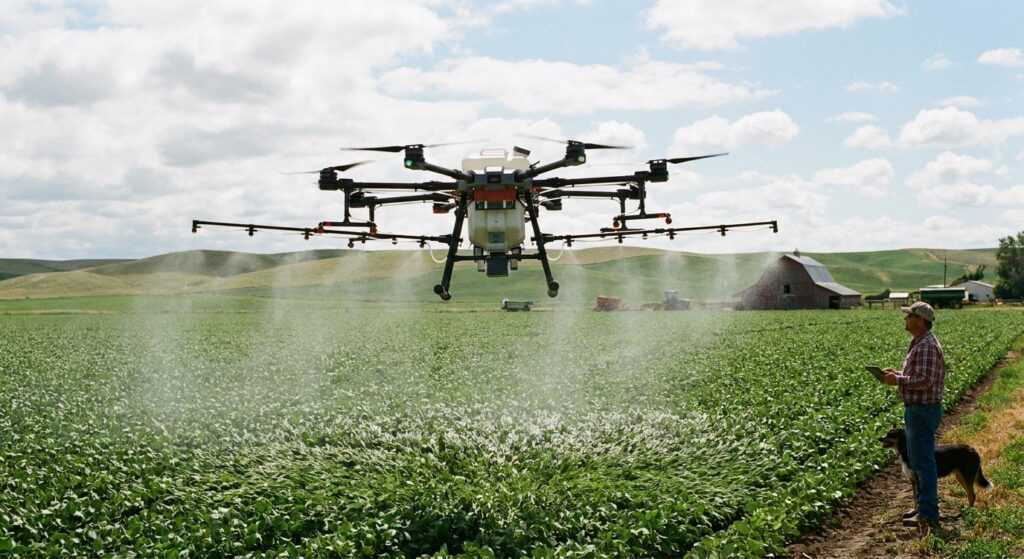
If you fly RPAS in Canada, June 30, 2026 is a date worth circling. Health Canada has introduced a new policy that allows drones to apply pesticides that were already approved for conventional aerial application. In plain terms: the spray plane finally has a smaller, quieter, far more precise competitor — and it’s legal.
Why this is a bigger deal than it sounds
Traditional aerial spraying by crewed aircraft has always come with baggage. Wind causes drift and uneven coverage, the aircraft burn through a lot of aviation fuel, and the typical payload and spray setup makes precise, low-altitude targeted application genuinely hard. You’re essentially trying to do delicate work with a blunt, fast-moving instrument.
Drones flip most of that on its head. They can launch from confined sites, fly lower and slower for much better precision, and cut fuel use and emissions in the process. For a lot of pest-management tasks, that makes them the easier and more sustainable tool — and it lets growers reach fields and awkward corners that conventional equipment can’t service well. Health Canada’s framing is that this removes a barrier and gives farmers another way to protect their crops more efficiently.
The part the headlines skip: you still need to be certified
This is the bit I want to flag for anyone reading this and imagining they can strap a tank onto a hobby drone next week. The policy permits the use case — it does not loosen the pilot requirements. To operate a drone for pesticide application, you have to comply with all federal and provincial/territorial laws, hold a valid drone pilot certificate from Transport Canada, and complete the necessary certification and training.
So this isn’t a free-for-all. It sits on top of the existing RPAS certification structure. If anything, it’s another strong argument for taking your certification path seriously — the advanced and complex operations world just got a real commercial application attached to it.
How we got here
This wasn’t a snap decision. Agriculture and Agri-Food Canada, Health Canada, and industry worked together to gather the evidence behind it. Health Canada ran a 30-day consultation on drone pesticide application starting February 23, 2026, and got more than 150 comments back — with notable support and a fair bit of pressure to move quickly ahead of the 2026 growing season. They also note that drone application doesn’t present any additional health or environmental risk compared to traditional aerial methods.
It also brings Canada in line with countries like Australia and Japan, where drones have already been doing this work. We were behind; now we’re caught up.
My take
As someone working through the RPAS certification ladder, this is exactly the kind of regulatory movement I like to see: a legitimate, science-backed commercial use case opening up, with the certification and safety scaffolding kept firmly in place. It’s a signal that drones are being treated as serious agricultural infrastructure, not novelty. For Canadian operators, the practical upshot is straightforward — if you’ve already invested in your certification, the list of things you’re legally allowed to get paid to do just got a little longer.